Key takeaways
- Reconciliation compares your records with the bank statement.
- Differences often come from timing, bank fees or entry errors.
- Follow five steps: match, spot differences, fix, document and confirm.
- Do it on a regular schedule, monthly for small businesses.
- Report suspicious transactions and bank errors instead of hiding them.
Good bookkeeping starts with a simple question: does what I wrote down match what the bank shows? Answering that question regularly is called bank reconciliation. It sounds technical, but it is a careful comparison of two lists. This guide explains it step by step, using made-up numbers and names.
What is bank reconciliation?
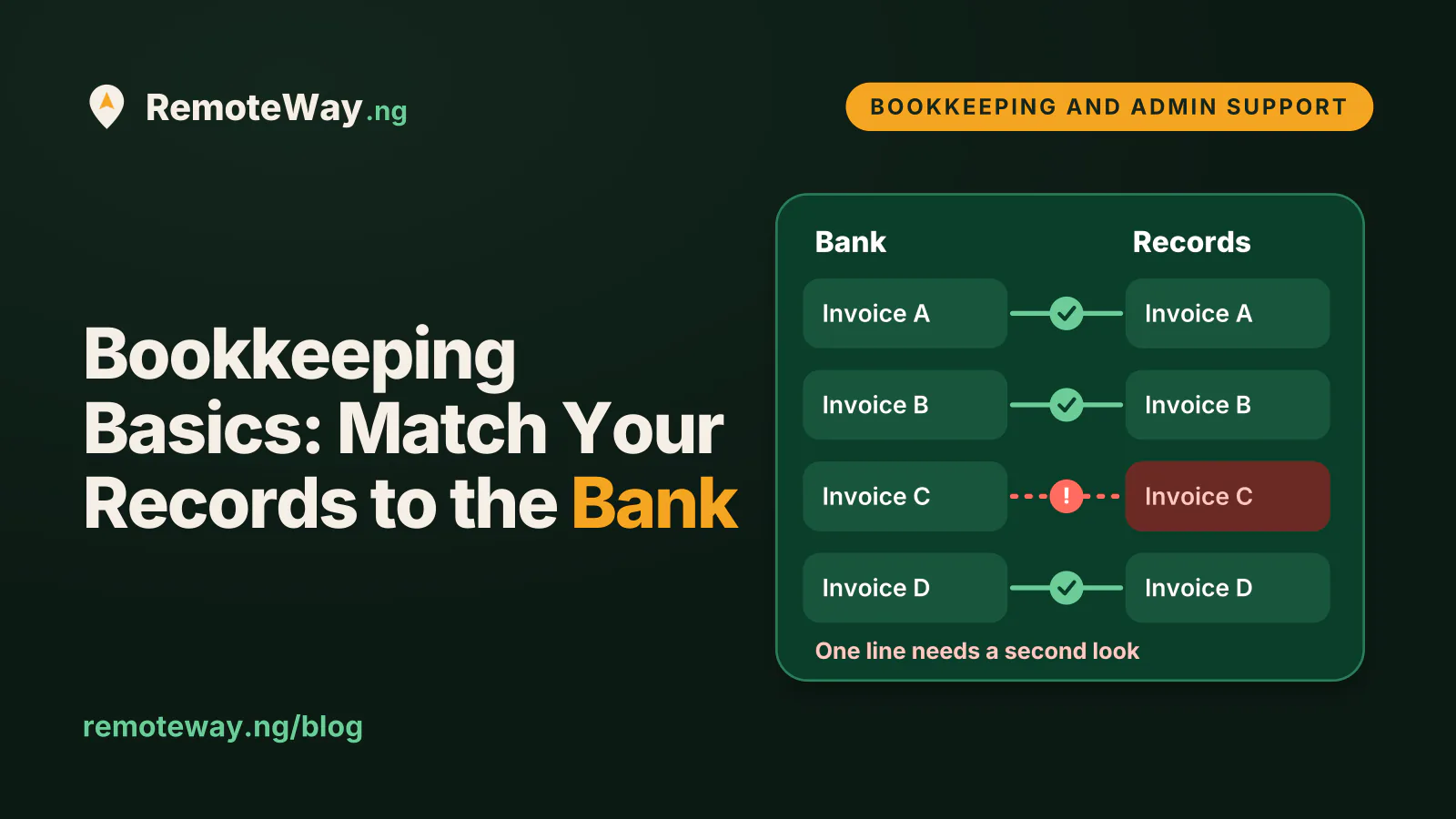
Bank reconciliation compares the bank balance in your own books with the balance on your most recent bank statement. Any difference is examined and corrected where appropriate. When you finish, both records tell the same story.
Why do the two records differ?
Differences are normal. The usual causes are:
| Cause | Example |
|---|---|
| Timing | You recorded a payment today, but the bank will process it tomorrow |
| Outstanding items | A cheque you issued has not been presented to the bank yet |
| Bank-only items | The bank charged a fee or added interest you have not recorded |
| Entry errors | A wrong amount, a duplicate or a missed entry on either side |
| Unknown transactions | A payment you do not recognise and must investigate |
What is the routine?
Use these five steps each time.
Step 1: Match the transactions
Put your cash record and the bank statement side by side. Compare them line by line, starting with amounts. Check deposits, withdrawals, transfers, fees and interest. Tick each matched pair.
Step 2: Spot the differences
Mark anything that appears in one record but not the other, anything entered twice and anything where the amounts differ.
Step 3: Fix your books
Record bank fees and interest, correct data-entry mistakes, and fix duplicates or omissions. If you think the bank made a mistake, contact the bank before you change your books. If a transaction looks suspicious, report it.
Step 4: Document what you changed
Write down the date, amount, account and reason for each adjustment. This gives a clear trail for you, a client or an accountant.
Step 5: Confirm the balances
Check that the adjusted book balance and the adjusted bank balance agree. If they do not, go back to Step 1 and compare again. Timing differences are recorded so they can be checked in the next round.
A small made-up example
Imagine a practice shop called "Ada's Stationery".
- The books show a balance of 100 units at the end of the month.
- The bank statement shows 120 units.
- The gap is 20. Ada issued a cheque for 25 units that the bank has not cleared yet, so the bank still shows that money. The bank also charged a fee of 5 units that the books do not show.
Fix the books first: subtract the 5 unit fee, so the books show 95. Then adjust the bank side for the timing difference: 120 minus the 25 unit cheque that has not cleared gives 95. Both sides now agree at 95. This is why the documentation step matters: next month you can check that the cheque cleared.
How often should you do it?
A small business with few transactions can usually reconcile monthly. As volume grows, weekly or even daily makes sense. Pick a schedule and stick to it. Reconciling often keeps each round small, and you find mistakes while you still remember the cause.
What mistakes should you avoid?
- Changing your books to match the bank without finding the reason.
- Ignoring small differences that repeat. They often point to a habit or a missing fee.
- Backdating corrections. Post corrections in the proper period and note them.
- Skipping the notes. A balance without notes is hard to trust later.
How can you practise?
Make a one-page bank statement and a matching cash list with twenty made-up entries, deliberately with a duplicate, a missing fee and one wrong amount. Reconcile them with the five steps and write a short note on each difference. Keep it as a sample. Accuracy is a skill many teams value, as you can see in what a virtual assistant does, where careful checking is part of every task. The same habit of checking numbers appears in data analytics.
Where can you learn it properly?
RemoteWay's Bookkeeping and Admin Support program is self-paced, with comprehensive training videos created by top experts in their fields, and teaches records, matching and reporting with practice tasks. We teach skills and do not promise jobs or income.
Frequently asked questions
What is bank reconciliation in simple words?
Bank reconciliation means comparing the cash records you keep with the statement from your bank to make sure they agree. You match each item, find anything missing or different, correct your records where they are wrong and note timing differences. The goal is two lists that tell the same story about your money.
Why do my records not match my bank statement?
Common reasons include timing, where a payment you recorded has not yet cleared; bank fees or interest you have not recorded; entry mistakes such as a wrong amount or a duplicate; and sometimes a bank error or a transaction you do not recognise. Work through each difference and find its cause.
How often should I reconcile?
A small business with few transactions can usually reconcile monthly. As the number of transactions grows, weekly or even daily reconciliation can make sense. What matters most is doing it on a regular schedule, so each round stays small and mistakes are found while you still remember what happened.
Sources
Ready to learn this properly?
Creating an account costs nothing. Every program is self-paced, with comprehensive training videos created by top experts in their fields. We teach skills. We don't promise jobs or income.
Keep reading
What Is Data Analytics? A Beginner Explanation
What data analytics is, the six steps analysts follow, the tools and skills involved, and how a beginner can practise with a small table and a clear question.
The Tools Remote Teams Use Every Day
A beginner guide to the tools remote teams use daily: chat, video calls, calendars, shared documents and task boards, and how to learn them with practice.
Prompting Basics: How to Ask AI Better Questions
Learn the basics of writing a good AI prompt: give context, say who it is for, ask for a format, add an example and check the answer before you use it.